
SEO v/s PPC or Both SEO and PPC: A Comparative Study
You will be intrigued to know that Google processes over 3.5 billion searches every day. That is about 40,000 per second! How in the digital world are you supposed to get a search engine like Google to notice that your business exists and rank it above your competitors? There are mainly two ways to market your business through search engines like Google. They are SEO and PPC Campaigns.
We have often felt, “Which is better: SEO or PPC?” This is not a question with a general answer, honestly, truly depends on your current situation, objectives and marketplace.
There are two key differences noticed between SEO and PPC: the first is how traffic is obtained and the second is where listings appear on the search results pages. SEO is a long term solution wherein PPC comparatively is a short term solution.
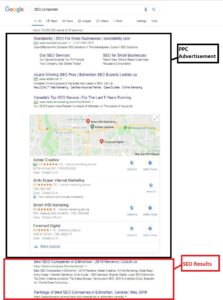
A vanilla search on Google regarding any keywords, for instance “SEO Companies” shows PPC advertisements on top of the search page and SEO results thereafter. An image displays the same as below:
The advantages of SEO
Awareness and Branding: SEO creates awareness about your business in front of potential customers using targeted keywords. To be visible around commercial search terms and informational queries related to your business area can have a positive branding benefit. Your brand can become associated with and trusted by searchers who are asking questions as they conduct the research that will lead to a purchase.
Credibility and trust: Having your site return in the organic results can influence your perceived credibility with an audience looking for your services. Many users skip ads and trust organic results more highly. Being visible gives your business that all-important stamp of approval.
Website traffic: SEO helps in increasing website traffic and thus, provides more opportunities to drive awareness of your business and educate a prospect as to why they would buy from you.
No or low Cost per click: Developing visibility through organic visibility will take time and effort (money), but there is not a direct charge for each impression or click. It will generally be more cost-effective than all other marketing tactics for delivering brand awareness and relevant traffic to your website
Return on investment (ROI): Organic search engine traffic can provide an improved ROI over traditional forms of paid media and certainly improve upon PPC
Sustainable Business Model: Unlike paid ad campaigns, organic traffic does not dry up the moment you stop paying. The organic traffic helps in supporting and making a business more sustainable even when marketing spend is cut back.
Improved click-through rate (CTR): A higher percentage of users click on the organic results and prefer to skip advertisements. While there are exceptions to this rule, you will generate more clicks from a highly placed organic listing than from a highly placed paid ad. To maximize visibility and clicks, you will want to have listings in the paid and organic results. Keyword-level experimentation is needed here to see if you are paying for clicks you would get for free or increasing overall clicks and CTR in both paid and organic — but to truly maximize results, strong visibility in paid and organic is needed.
Strategic advantage: Once you have established yourself in the organic results, your competitors can’t simply buy their way in (assuming you have done things the right way). This can provide a strategic advantage over the competition if they are relying on paid search.
The disadvantages of SEO:
Speed: In many cases, organic traffic can be slow to come by and it takes to build up traffic flow. If you are just starting out, and the keywords you are targeting show results of pre-established companies and it takes time and effort to get views.
Content Assets and Blogs: You may also need to develop content assets to achieve strong organic visibility. Content development is real reason behind the organic growth of a business. Link building can be difficult to master, and often, a strategy is needed, along with expert support.
Advantages of PPC Campaigns
Page Position: PPC ad campaigns help us to position our brand on top of the search page linking to our website. A user will always see the paid search ads, even if they choose to scroll past them.
Marketing Messaging: Calls, locations, site links, pricing and bullet points (callouts) are just some of the options for creating ads that dominate the page.
Visual Ads: Google provides the option of visual shopping ads that can help a user see what they will be clicking on. This kind of ad can really improve the click-through rate by offering a feature not available in organic search.
Brand visibility. Running paid search advertisements gets you seen by the right people. Such visibility will pay dividends to your marketing efforts.
Budget. PPC allows for a tight control of budget. Determine how much you are willing to spend per day (ideally with some initial and ideal ideas of returns), and set that fixed limit.
Targeting: PPC provides a laser-targeted way to get in front of potential customers. Ads can be targeted by search keywords, time of day, day of the week, geography, language, device and audiences based on previous visits. In comparison, the Organic traffic or SEO is far more scattered.
Speed: While developing good organic visibility can take time, a PPC campaign can be created in days and ramped up in weeks. There is no faster way to get in front of customers at the very moment they are primed to buy than paid search engine advertising.
Marketing intelligence: While organic search largely hides keyword data in the name of privacy, there is no such restriction with paid search. With conversion tracking and a solid integration with analytics software (like Google Analytics), we can determine what keywords convert and at what percentage and cost.
Stability: Careful use of match types and analysis of the search term reports allow for the removal of junk search and an increase in ROI over time.
Cost: On the contrary to what is said about PPC campaigns, a well-managed PPC campaign can be a low-cost way to generate leads for your business. If you are a local business targeting a small geographic area and a small set of keywords, you may find that you can generate more than enough leads without breaking the bank.
Disadvantages of PPC Campaigns
In similarity to organic search, there are also some pitfalls as well associated with paid campaigns:
Expensive if not well directed: PPC can be expensive. If you are not targeting well, those costs can spiral. Paid search advertising is, as the name suggests, paid — so it requires constant investment.
Short Term Gains: The moment your ads go away and your lead generation dries up. So long as you have a solid acquisition cost, then this should not be a problem.
It is not unusual to get into bidding wars with other advertisers, which can drive costs up. As you start to run your ads, often you are taking a bite out of some other advertisers’ digital apple. Doing so can result in some spiraling costs.
Replication: Strategically, PPC is relatively easy to replicate. If a competitor notices you are running ads, they can run ads. Your messaging can be imitated. Your entire marketing funnel can be easily evaluated by competitors.
Successful PPC needs skilled management and optimization — from monitoring bids, Quality Scores, positions and click-through rates. Some of this can be done with scripts, but if you are too busy to do this properly, ensure you have an expert on hand to take care of keeping your account in tip-top shape.
Listing Location:
If you are a small business, chances are you will want to target people near you. Another difference in SEO vs PPC is how you can optimize for local search. If you are running an ad campaign, you can use location based keywords or target a specific geographic location.
SEO proves to be a little bit more difficult. In order to rank locally you must make sure that your business name, address and phone number are the same across all platforms – consistency is key here. Other factors that can improve your rankings in local SEO include optimizing your Google My Business account and having a responsive website design.
SEO or PPC or Both SEO and PPC
Coming back to the question of SEO v/s PPC? We believe that both have pros and cons and work best when supporting each other synergistically and creating results that are greater than they could individually. As per our experience, the benefits of running SEO and PPC together include:
- Keyword and conversion data from PPC through Google Analytics can be fed into organic search (SEO) and thus, improving the results obtained in the long run.
- The total volume of traffic can be increased by targeting clicks in paid and organic for high-performing keywords.
- Keywords switching between SEO and PPC enable a balanced approach towards better marketing strategy.
- PPC allows you to stay in front of visitors combined with touch via organic search and customize messaging around their engagement with your site.
- Test your keyword strategy in PPC before committing to long-term SEO strategies.
- Target users at all stages of the customer journey from research to comparison to purchase with commercial keywords.
- Increase confidence and awareness by having both strong organic and paid visibility.
Therefore, it is evident that results are improved in each channel by utilizing both paid and organic. This will not be right for every business, but for high-growth, aggressive marketing, you will want to develop a holistic search engine strategy rather than look at SEO or PPC in isolation.
Looking for SEO company in Vancouver or want to set up and run PPC campaigns? Email us at info@richoakadvertsing.ca.